Part 1 of a 4-part study: What a first visa really costs
Where does the money go?
When people price a move abroad, they start with the government's fee. On most work routes, that is the smaller part of the bill.
We added up what one person pays for a first visa on work, remote-work, family, retirement and investment routes across the Americas, Europe and Asia-Pacific: the government's fees, what firms typically charge to handle the application, and the extras each route requires. This part shows how the bill is made up.
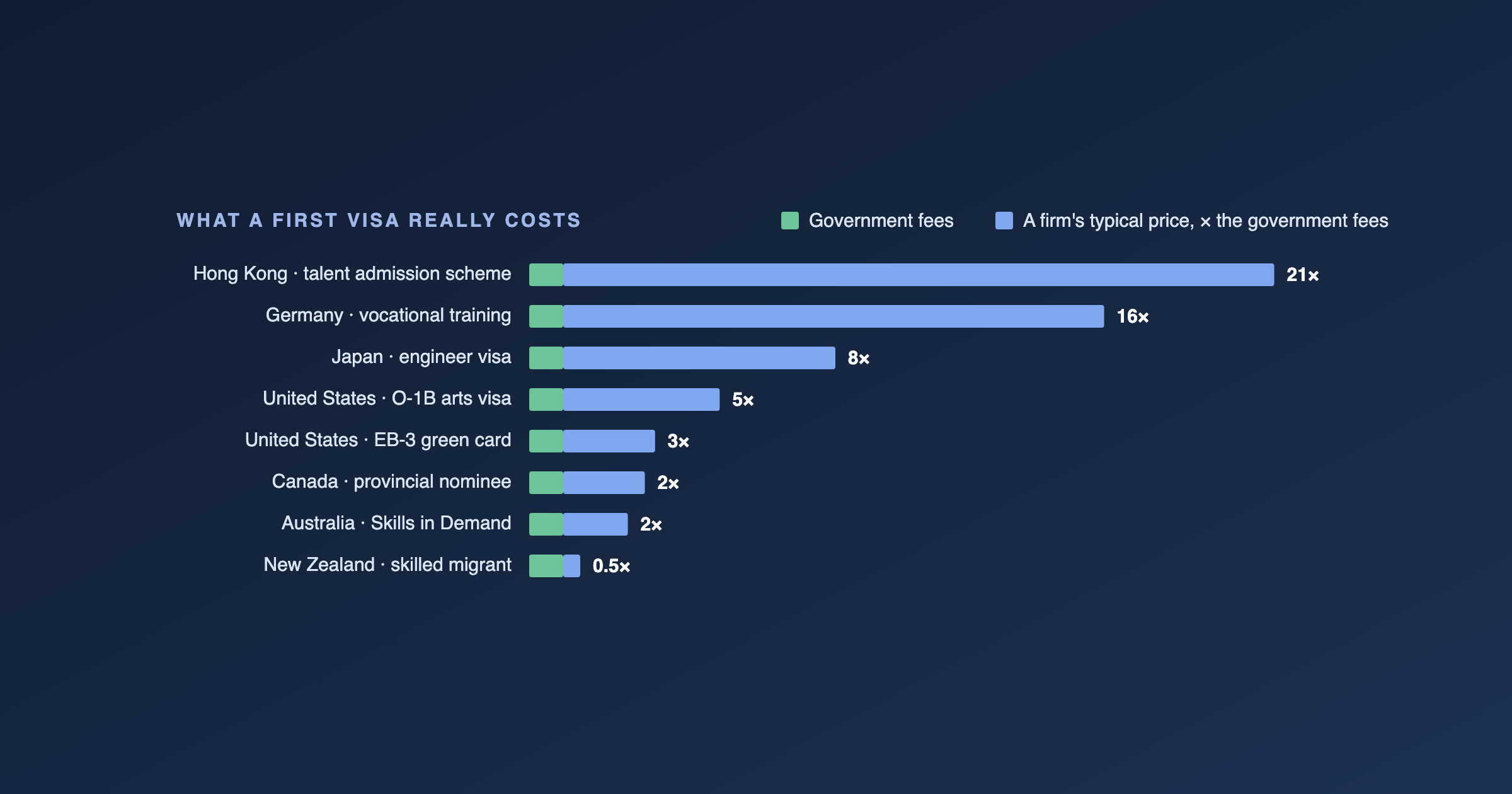
Each work route's bill, in multiples of its government fees
Blue: the middle of firms' published prices for the whole application, as a multiple of the government fees.
Start with the fee on the official page. Here every route's government fees are drawn the same length. This is the number most people see first.
Now add a firm's typical price for handling the whole application. On most routes, the bill at least doubles.
New Zealand is the exception. Its government fee, NZD 6,450 at the standard rate, is more than the NZD 3,000–3,500 a firm typically charges.
The widest gaps are where the government charges little. Germany's vocational-training visa: EUR 175 to the government, about EUR 2,780 to a typical firm. Japan's visa: JPY 15,000 against about JPY 120,000.
Add the required extras that have a published price, such as medical exams and language tests. Police certificates, apostilles and translations are required too, but their cost depends on your home country, so no honest total can include them.
Some routes ask you to show money you keep. Canada's Federal Skilled Worker route asks a single applicant to show CAD 15,263, more than twice the typical amount spent.
Seven things the bills show
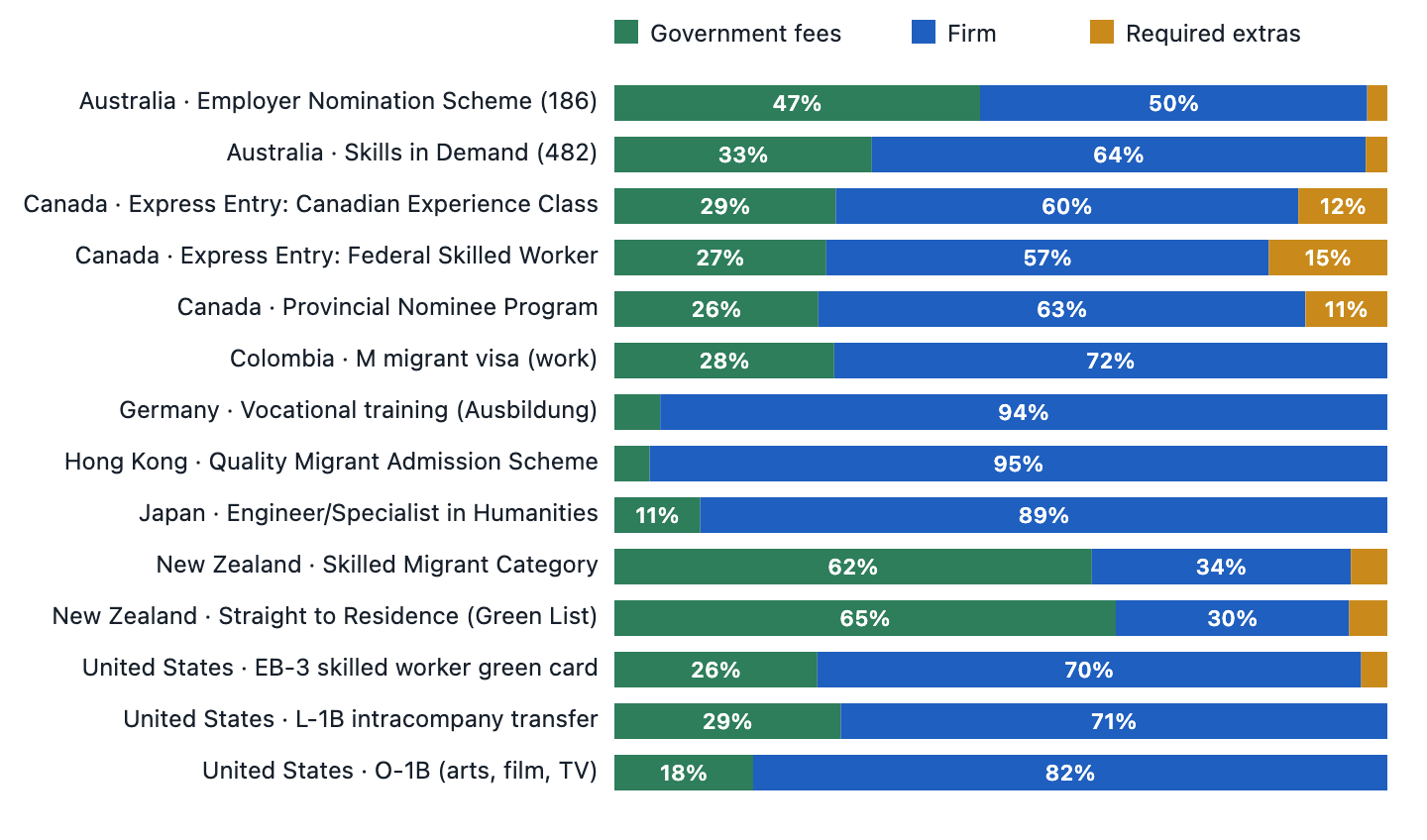
- The firm is typically the biggest single cost. On the work routes in this study, we observe that a firm's typical price for the whole application is larger than all the government fees together, except on New Zealand's two residence routes, where the government charges NZD 6,450, and Australia's Employer Nomination Scheme, where the two are about equal.
- The gap is widest where governments charge little. Hong Kong's Quality Migrant Admission Scheme costs HKD 1,900 in government fees; firms typically charge about HKD 39,800 to arrange it. Germany's vocational-training visa costs EUR 175; firms typically charge about EUR 2,780. Uruguay's residence routes cost about USD 100 in government fees and typically about USD 2,600–2,800 through a firm.
- Family routes are where governments charge the most. Australia's partner visa costs AUD 9,600 in government fees for the main applicant, and New Zealand's partner, parent and dependent-child visas NZD 3,230–13,300. On these routes the government, not the firm, takes the larger share.
- On investment routes, the fees are small next to the investment. Panama's Qualified Investor routes typically cost about USD 8,500 in fees and a firm's help, beside an investment of USD 300,000–750,000. Colombia's investor visas typically cost about USD 1,270 beside an investment of at least COP 612.8 million.
- On low-wage work routes, the law sets the price. In Singapore, Hong Kong and Malaysia the worker pays no government fee, and the law caps what an agency may take from them. On US seasonal work visas and Canada's temporary foreign worker permits, no recruitment fee may be charged to the worker at all. Yet in Canada, a licensed adviser's help with the worker's own permit typically costs CAD 1,000–4,000, beside a government fee of CAD 240.
- Many required extras have no published price. Police certificates, apostilles and sworn translations are required on most routes, but what they cost depends on your home country and on who does the work.
- The money you must show can dwarf what you spend. Canada's Federal Skilled Worker route asks a single applicant to show CAD 15,263 in settlement funds, more than twice the typical total spent. That money is kept, but you need it in hand.
An ordinary quote, and what went wrong
She had been in New Zealand since 2017, with a job and a post-study work visa. In June 2024 she signed with an immigration agency to apply for skilled residence. The quote was ordinary: a professional fee of NZD 3,500 plus GST, and NZD 4,290 for the government's own fee. On the day she signed, she paid NZD 7,165.
The adviser lodged her expression of interest, and Immigration New Zealand invited her to apply the same day. The residence application was never filed. For seven months she was told it was progressing. When her work visa ended, the interim visa she had been promised did not come, because there was no application. She was now in New Zealand unlawfully and could not work.
- 24 June 2024. Signs with the agency and pays NZD 7,165.
- 26 June 2024. Invited to apply for residence, with a deadline of 26 October 2024.
- 28 January 2025. Her work visa expires. No application was ever filed.
- 21 February 2025. Immigration New Zealand approves the work visa she applied for herself.
- 10 June 2025. A disputes tribunal awards her NZD 7,760 against the agency.
- 16 February 2026. The disciplinary tribunal finds the adviser was dishonest.
NZD 3,500 is exactly the typical price we found for this route. A fair quote is not the same as a safe service. Ask for the application number once it is filed, check whether the adviser's licence is full or provisional, and know your own visa's end date.
Source: Immigration Advisers Complaints and Disciplinary Tribunal, [2026] NZIACDT 9, 16 February 2026. The complainant is protected by a suppression order and is not identified here.
The share of each work route's bill
How to cite this study
Immimaps (2026). What a first visa really costs. A 4-part study, updated 10 November 2026. https://immimaps.com/journal/study/what-a-first-visa-really-costs-part-1
The text, charts and dataset are free to reuse under the Creative Commons Attribution 4.0 licence. You may copy, adapt and republish them, including commercially, if you credit Immimaps and link to the study. Figures we quote from other sources, such as government fee pages and the Ethical Recruitment Atlas, belong to those sources; credit them too.