Part 4 of a 4-part study: What a first visa really costs
How do we know, and what has changed?
Every figure in this study comes from a government's published fee or a firm's published price, and links to its source in the dataset.
This part explains how the totals are worked out and what they leave out. It lists every change to the figures, newest first. When a government changes a fee on one of these routes, the change is added here with its date and source.
How the figures are worked out
- The total is what one person pays for a route's first visa or permit: the government's fees for the main applicant at the standard rate, a firm's typical price for the whole application, and required extras with a published price in the route's currency.
- Not in the total: money you show and keep, the investment itself, deposits a government holds, flights, rent, fees for family members, later stages, and costs that are the employer's by law.
- Firms' prices come from their published prices for the whole application. "Typical" is the middle price we observed; your own firm's price can sit anywhere in the range or outside it. Prices quoted in another currency were converted at fixed rates dated 2 November 2026.
- Amounts in different currencies are never added together. Nothing here predicts what your own application will cost.
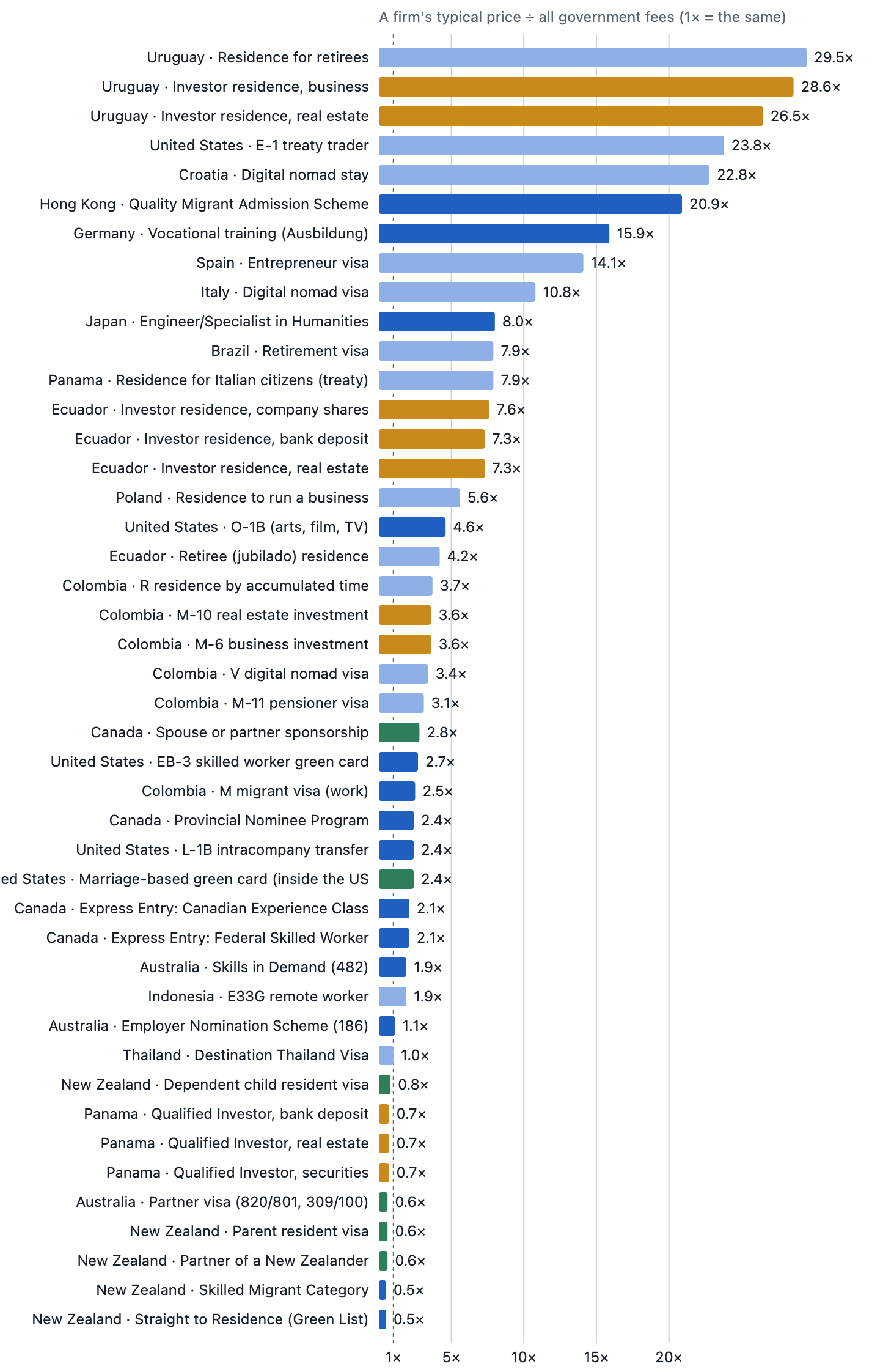
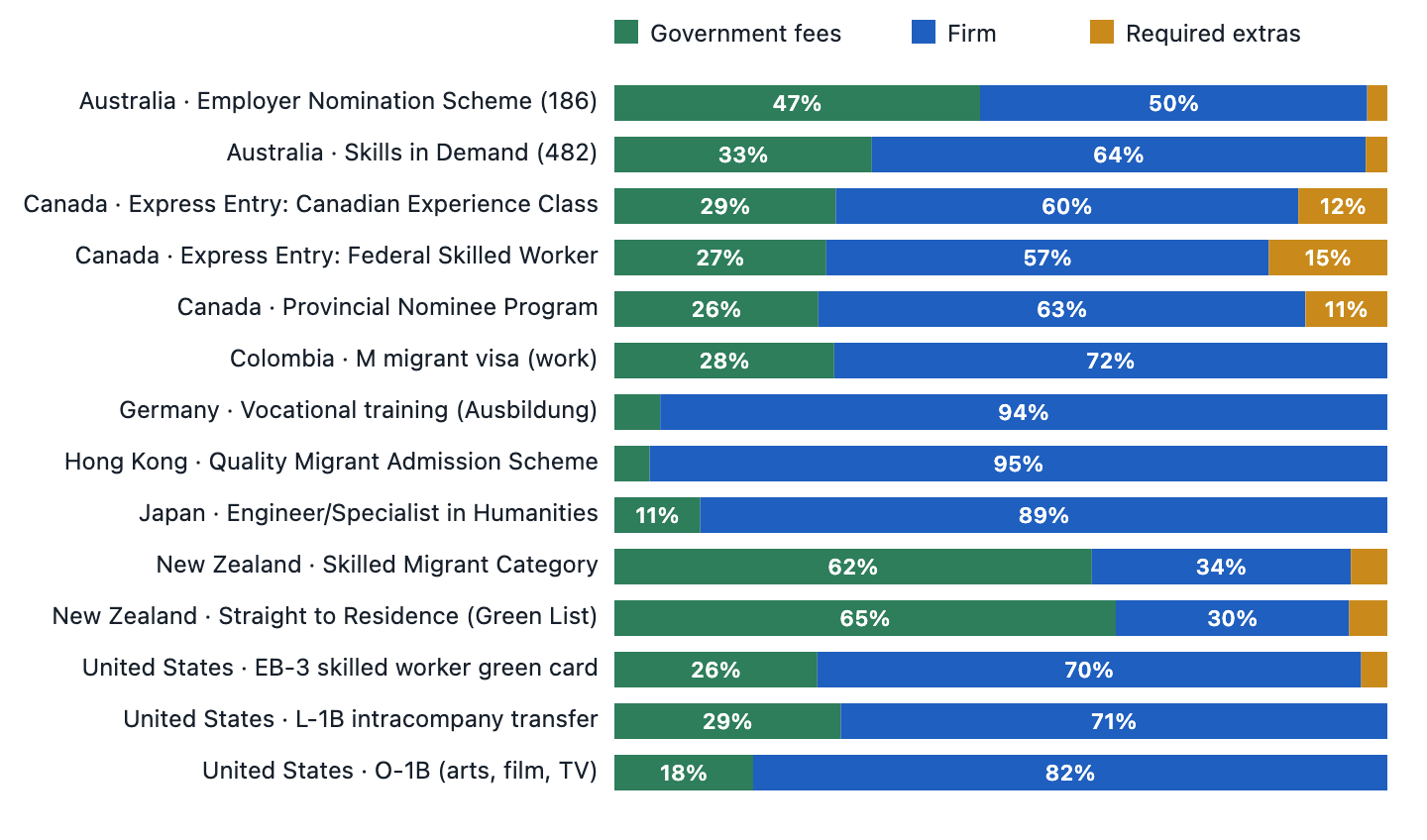
Download: the data, one line per cost with its source (CSV) · chart: a firm's price against the government fees · chart: where the money goes
What has changed, and when
New entries are added at the top when a government changes a fee or a requirement on a route in this study. Changes made before the study began, and already in the figures, are listed underneath.
10 November 2026 · Second edition. More remote-work, business and retirement routes, and new family and investment routes, each with prices from at least five independent firms. A new section sets out what the law lets anyone charge a worker on low-wage routes. Corrected: Colombia's visa fees now follow the table in force since 1 April 2026 (USD 260 for a migrant visa, USD 239 for a resident visa); the first edition used the earlier issuance fee. Medical-exam prices updated: Australia to the appointed provider's published fees (AUD 283–392), New Zealand to clinic prices of NZD 195–790. Sources: Colombia's Resolution 3969 of 2026, art. 4; Bupa Medical Visa Services; clinics' published fees.
8 November 2026 · Study started. First edition. Government fees, firms' published prices and required extras, each with its source.
Already in the figures
1 October 2026 · Japan · fee. Someone already in Japan changing to an Engineer/Specialist status now pays JPY 33,000 for a one-year grant at the counter. Applicants from abroad pay the consular visa fee instead. Source: Immigration Services Agency of Japan, fee schedule.
1 July 2026 · Japan · fee. The consular visa fee became JPY 15,000 for a single entry and JPY 30,000 for multiple entries. Source: Japan's consular visa fee schedule.
1 April 2026 · Colombia · fee. New visa fees: USD 56 to have an application studied, then an issuance fee by visa type (USD 138 for the digital nomad visa). Source: Cancillería de Colombia.
July 2025 · United States · not yet charged. A USD 250 visa integrity fee was enacted but is not yet collected: it is not on the State Department's fee schedule and has no start date. It is not in the figures. Source: US State Department fee schedule.
16 June 2025 · Spain · fee. Spain's fee order set the residence fee at EUR 10.94, the first self-employed work authorisation at EUR 203.84 and the first identity card at EUR 16.08. Source: Boletín Oficial del Estado, BOE-A-2025-12056.
How to cite this study
Immimaps (2026). What a first visa really costs. A 4-part study, updated 10 November 2026. https://immimaps.com/journal/study/what-a-first-visa-really-costs-part-1
The text, charts and dataset are free to reuse under the Creative Commons Attribution 4.0 licence. You may copy, adapt and republish them, including commercially, if you credit Immimaps and link to the study. Figures we quote from other sources, such as government fee pages and the Ethical Recruitment Atlas, belong to those sources; credit them too.