Where Immimaps Gets Its Answers

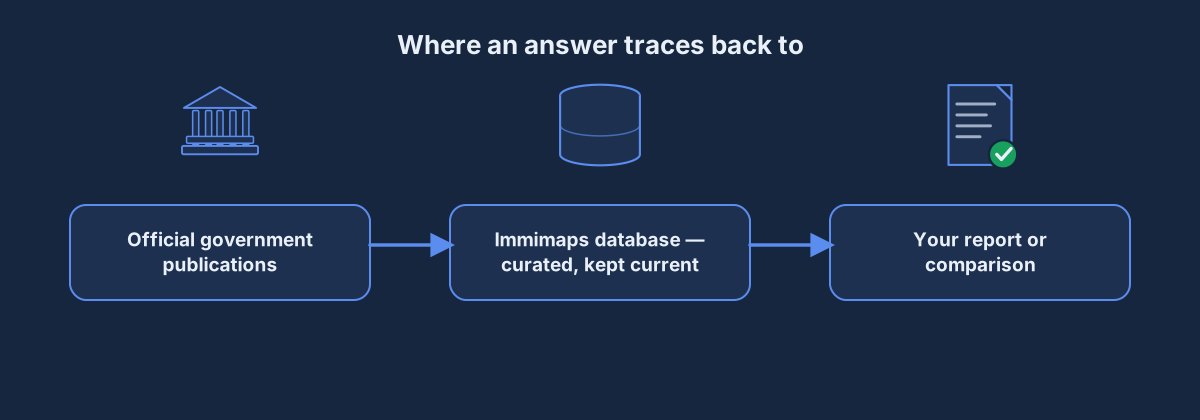
Every answer Immimaps gives you traces back to a database of official immigration program rules that our team builds and maintains from government sources. We deliberately don't rely on a general web search or an AI model's own memory to fill in the facts, because both are unreliable in exactly the situation where reliability matters most.
Why this needed to be said explicitly
If you've used an AI chatbot to ask about a visa program, you've probably noticed it answers confidently even when it's wrong. That's not a flaw specific to one product — it's how these systems work when they're drawing on general training data instead of a checked source. A general-purpose AI model has read a lot about immigration on the internet, including outdated blog posts, marketing pages, and forum arguments, and it can't reliably tell which of those are still true. It will still give you an answer, phrased with total confidence, because "I don't actually know" isn't the kind of thing these models are built to say.
A plain web search has a related problem: the top results are often the pages that are best at ranking, not the pages that are most current or most accurate. Marketing sites are very good at ranking. Official government pages, updated the day a rule changes, often are not.
What we actually built instead
Immimaps maintains its own database of official immigration program rules: minimum investment amounts, income and asset requirements, processing steps, tax details, and program-specific conditions. This isn't scraped automatically and left untouched — it's sourced from government publications and kept current by our team on an ongoing basis, as rules change.
When you compare pathways, or run a document through the free check, the answer you get is built from that database. If a proposal claims a cost figure, our check compares it against the real published figure for that program — not against an estimate, and not against what a similar program in a different country typically charges.
What this means in practice
It means an answer from Immimaps should be traceable. If a report flags something, it's because a specific rule in our database says something different from what the document claims — not because a general impression of "this looks risky" got attached to it. It also means we're honest about the edges of what we know: where our data on a specific program or a specific detail is limited, our reports say so, rather than filling the gap with a plausible-sounding guess.
This is also the reason you won't find success rates or approval percentages anywhere on the site. A number like that would need to come from somewhere — real outcome data across enough cases to mean something — and we don't have that in a form we'd trust to publish.
Rather than estimate, we leave it out.
News and our thoughts — not legal advice or consultation.
How current is the data, really?
Immigration rules change — sometimes quickly, sometimes with little public notice. We update the database on an ongoing basis as changes are published, rather than on a fixed yearly cycle. If a figure in one of your reports ever looks out of date, we want to know about it. We treat a stale data point as an urgent problem to fix, not as routine feedback to file away — because the entire premise of Immimaps depends on this database being right.
Where this shows up
You'll see this database at work in two places. When you compare pathways to figure out where you might go, the comparison is built from it. When you run the free document check on a proposal or contract, the check runs against it. Both features are reading from the same source, so you're not getting a different standard of accuracy depending on which one you use.
See it for yourself
The clearest way to see this in action is to run a real document through the check — you'll see exactly which rule a flag is measured against, not just a vague warning. Try the free document check, or start at the welcome page if you're comparing countries from scratch. More on how we handle accuracy and updates is in our FAQ.