What Happens to the Documents You Upload
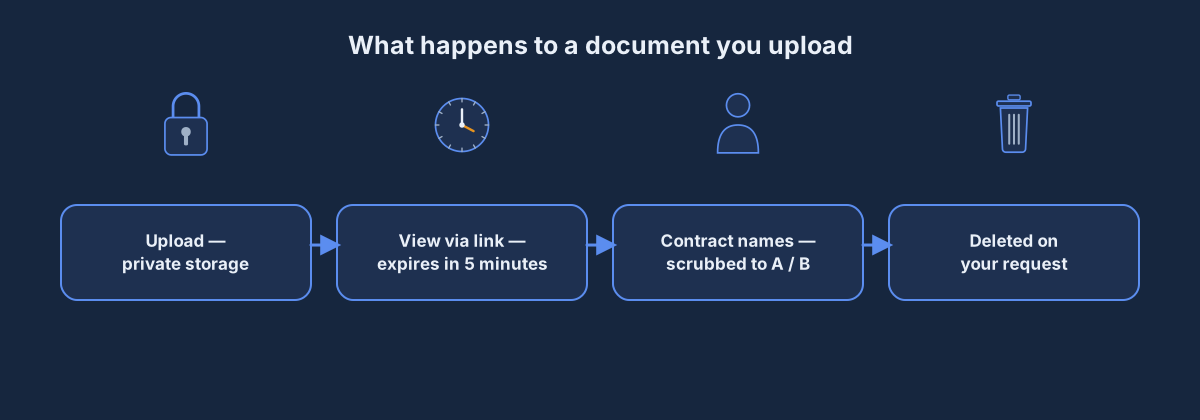
Paste the text or upload a file — either way, your proposal or contract is handled privately, never as a public link. Upload a file, and it's stored in private, non-guessable storage; to view it again, we generate a download link that only works for five minutes and only for you — or, if you've asked for help, a small support team. Paste the text instead, and there's no file at all: just the text itself, saved with your submission so your report can be produced and reopened. You can ask to have either one deleted at any time.
Where the file actually goes
When you upload a proposal or contract, it's saved under a private storage location that isn't guessable and isn't public. Nobody can find it by searching, browsing, or guessing a URL. If you're not signed in, that private location is tied to your session rather than to an account — it still isn't public, it's just not linked to a login.
When you or our support team need to look at the file again — say, to help with a question about your report — we don't hand out a permanent link. Instead, the system generates a fresh, temporary download link that expires after five minutes and is restricted to you (or staff helping you, when you've asked for that). After it expires, that specific link stops working; a new one would need to be generated to view the file again.
What happens when you paste text instead of uploading a file
If you paste the proposal or contract text directly into the box instead of uploading a file, the process is different in one important way: there's no file. Nothing gets written to private storage, and there's nothing for a temporary download link to point to — the five-minute link described above only exists when a file does. Instead, the text you pasted is kept with your submission itself, so the check can produce your report and so it can be reopened later.
Everything else about how that text is handled matches the file path exactly. The consent choice — the checkbox that lets you decide whether your submission can help improve future checks — applies to pasted text the same way it applies to an uploaded file, with the same wording and the same effect if you leave it unchecked. And if you paste a contract rather than a proposal, the same name-scrubbing described below runs on the text you pasted before anything from it reaches our shared research library — pasting instead of uploading a file doesn't skip that step.
What happens when a contract is read
Contracts are handled with an extra layer of care, because they typically name two real parties — you and the firm. When our system reads a contract, it works out who's who and labels them "Party A" and "Party B" internally. Before any excerpt from your contract is ever saved into our shared research library — the pool of anonymized examples we use to keep the check accurate for future users — real names are replaced with those neutral labels. Real names aren't kept in that shared library.
This means the substance of what you signed — the terms, the numbers, the structure of the agreement — can help make the check better for the next person, without your name or the firm's name traveling with it.
News and our thoughts — not legal advice or consultation.
What we store, and what we never do
| We store | We never do |
|---|---|
| An uploaded file, in a private, non-guessable storage location | Post a public link to your file |
| A temporary download link that expires after five minutes, for an uploaded file | Hand out a permanent, non-expiring link |
| Pasted text, kept with your submission — no separate file is created | Create a file, storage entry, or downloadable link for text you paste |
| Neutral labels — "Party A" / "Party B" — for contract excerpts kept in our shared research library | Keep real names in that shared library |
| Your submission, tied to your account or your session | Share your document with the firm named in it, with advertisers, or with anyone outside the small support team helping you |
Do you need an account for this to apply?
No. This privacy handling applies whether or not you're signed in — the free document check needs no account, and the storage and access rules above apply the moment you submit, whether you paste text or upload a file.
Getting your document removed
If you want a file or a pasted submission removed, email support and we'll delete it — that works the same way whichever one you sent. This isn't a multi-step process buried behind a form — a direct request is enough. If you do have an account and later decide to delete it, that removes your submissions, files and pasted text alike, along with everything else tied to the account; it isn't a soft delete you can undo, so it's a genuine removal, not an archive.
Who else can see it
Your document isn't shared with the firm named in it, with advertisers, or with anyone outside the small support team who might help you if you ask a question. We don't sell or rent personal data, and we don't share submissions for advertising. Data only goes to the vetted processors that run the underlying service — hosting and similar infrastructure, operating under contract — or when the law requires it.
Why we built it this way
People paste or upload real financial and legal documents to this check, often before they've told anyone else they're considering a move. That's a level of trust that has to be earned by how the system actually behaves, not just by a promise on a page. Expiring links for uploaded files, no file created at all for pasted text, name scrubbing before anything joins a shared library, and a real deletion path when you ask for one are the concrete parts of that — not slogans, but specific things the system does or doesn't do with what you send us.
Not slogans, but specific things the system does or doesn't do with what you send us.
If you're ever unsure what a specific part of the process means for your situation, asking is faster than guessing — support exists for exactly that.
Questions about a specific document
If you have a document-specific question — for instance, about a file you've already uploaded or text you've already pasted — email us and we'll help directly. For general privacy questions, our FAQ covers account deletion, data sharing, and using the check without an account in more detail. Ready to check a document yourself? Start the free document check — you now know exactly what happens to what you upload or paste.