Red Flags in Agency Proposals: What Our Check Looks For

Most problems in agency proposals fall into a small number of general patterns, not a long list of unrelated mistakes. Knowing the pattern is often more useful than knowing any single example, because it tells you what question to ask about a proposal you're holding right now — which is exactly what our free document check is built to test for.
None of the patterns below describe a real person, a real case, or any specific company. They're general categories, the kind of thing that shows up across many different proposals in many different countries. If you want to see whether your specific document has one of these problems, the fastest way is still to run it through the check.
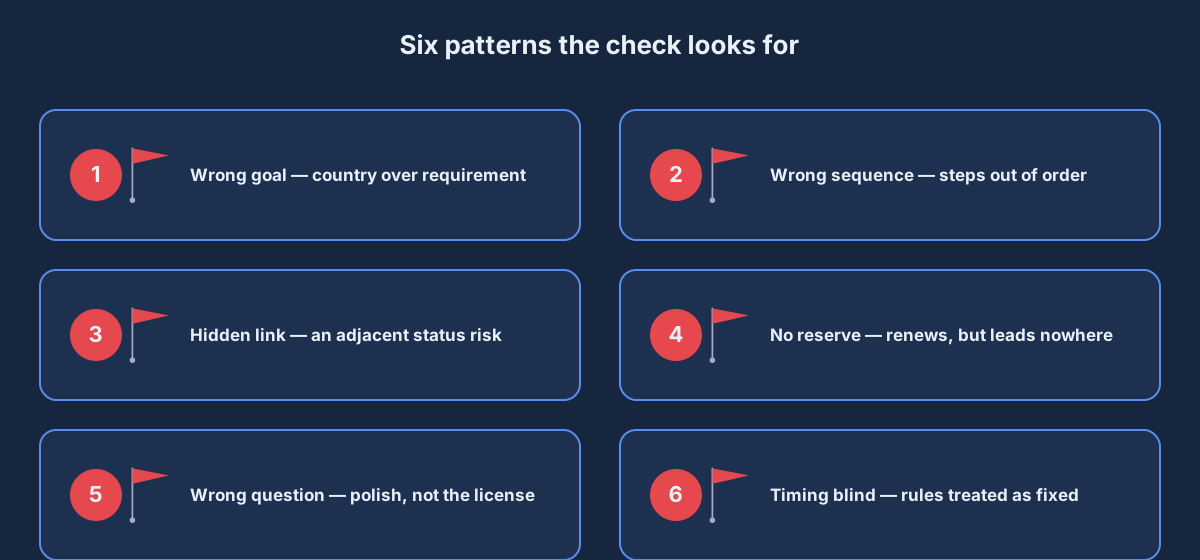
1. The wrong goal — optimizing the country instead of the requirement
A proposal can be built around a country's appeal — the lifestyle, the climate, the reputation — while glossing over the specific requirement that actually decides whether the pathway works for you. A country is a means, not a goal, and a proposal that sells the destination instead of clarifying the real gate (a licensing requirement, a sponsorship condition, a regulated profession) can leave you excited about a place without ever confirming you can actually get there.
What to check: does the proposal name the specific requirement that determines eligibility, or does it mostly describe how nice life will be once you arrive?
2. The wrong sequence — steps presented out of order
Immigration pathways often require steps to happen in a specific order, where an earlier stage must be complete before a later one can even be filed. A proposal that skips over this, or implies you can go straight for a later milestone, can set you up to file something that gets refused — not because you didn't qualify, but because you weren't eligible to apply yet.
What to check: does the timeline in the proposal show every required earlier stage, or does it jump straight to the outcome you actually want?
3. The hidden link — a decision that touches immigration status without saying so
Some of the riskiest decisions in a relocation don't look like immigration decisions at all — moving savings between accounts, changing jobs, or restructuring how you're paid can quietly affect your tax residency or your status, even though nobody labeled the decision that way. A proposal that only covers the immigration filing itself, with no mention of these adjacent risks, may be technically accurate while still leaving a real gap.
What to check: does the proposal mention anything about how your other financial or employment decisions might interact with your new tax residency or status — or is that left entirely unaddressed?
4. No reserve — a status that renews forever but leads nowhere
Some pathways can be renewed indefinitely without ever accruing toward permanent residency or citizenship. That's not automatically a problem — plenty of people are fine with a status that just needs renewing — but a proposal that doesn't make this clear can leave you assuming years of legal residence are building toward something permanent, when structurally they aren't.
What to check: does the proposal say plainly whether the pathway leads toward permanent residency, or is it a renewable status with no such path at all?
5. The wrong question — checking the polish instead of the license
A professional-looking proposal, a confident sales conversation, and a well-designed website all answer the question "does this feel trustworthy?" None of them answer the actual question that protects you: is this representative permitted to do this work, and are they on the relevant public register? The two questions are easy to confuse, and only one of them is free to check yourself.
What to check: can you find this representative or firm on the country's official register of licensed immigration representatives — not just their own website's claims about themselves?
6. Timing blind — assuming the rules and the clock stay fixed
A proposal often describes a timeline as if it were guaranteed: apply now, wait this long, receive this outcome. In reality, processing queues and program rules can both change after you've started, sometimes applying retroactively to people already in the process. A proposal that presents today's timeline as a fixed promise, rather than a current estimate, is understating a real risk.
What to check: does the proposal distinguish between the program's current rules and a guarantee that those rules will still apply by the time your case is decided?
What our check actually does with these
The free document check tests your specific proposal or contract against the real, current rules for that program — not against the patterns above as a checklist, but against the actual requirements, sequencing, and terms the program has published. These six patterns are simply the shapes that problems tend to take; the check itself works from your document and the program's real rules, not from a general theory.
News and our thoughts — not legal advice or consultation.
Check your own proposal
If any of the above sounded familiar while reading, the fastest way to find out is to run the actual document through the check — free, anonymous, and it will show you specifically what matches the program's real rules and what doesn't. Start the free document check. For more on how the check works, see our FAQ.